
Blog
Why Global Buyers Are Sourcing Indian Handicrafts in 2025
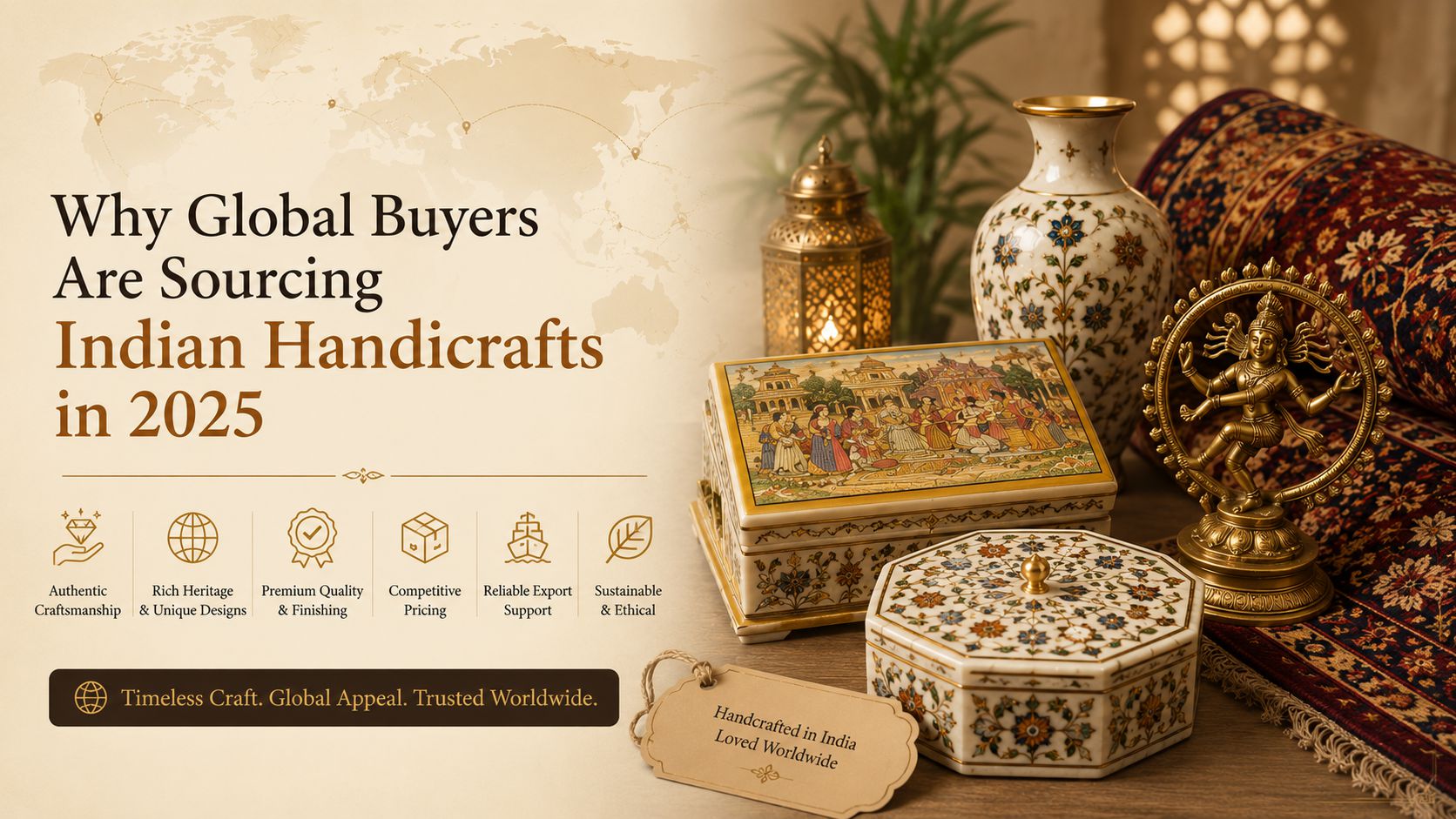
The global home décor market is undergoing a quiet but significant shift. As consumers in the USA, UK, Germany, Japan, and beyond move away from mass-produced goods, demand for handcrafted, traceable, and culturally meaningful products has accelerated — and India is at the centre of that shift.
India produces more varieties of handicrafts than almost any other country on earth. From the marble inlay ateliers of Agra to the brass foundries of Bastar, the silk looms of Kashmir to the jute weavers of West Bengal — each region has a distinct craft tradition, a distinct material, and a distinct aesthetic. For global buyers looking to offer something genuinely different, this breadth is invaluable.
What’s driving demand in 2025?
Several converging trends are making Indian handicrafts increasingly attractive to international buyers:
Sustainability expectations. Buyers in Europe and North America now face pressure — from consumers and increasingly from regulation — to demonstrate the provenance and environmental footprint of their products. Handmade Indian goods, produced by artisan clusters using natural materials, score well on both counts. Jute, stone, natural wood, cotton and silk are biodegradable, low-impact materials. The production is human-powered, not machine-powered.
The retreat from sameness. Every major home décor trend in the past five years — cottagecore, wabi-sabi, maximalism, biophilic design — has pushed buyers toward objects with texture, irregularity, and story. A hand-knotted Kashmir carpet with 800 knots per square inch. A Dhokra brass figure cast by hand in an ancient technique. A marble vase inlaid with lapis lazuli. These objects resist the perfectly identical character of industrial production. That is precisely their appeal.
Price competitiveness. Despite their premium quality, Indian handicrafts remain price-competitive against comparable goods from Europe or China. The combination of skilled artisan labour, low cost of raw materials, and established export infrastructure means buyers can achieve strong margins.
What should buyers know before sourcing from India?
Working with Indian handicraft suppliers is rewarding but requires understanding. Lead times are longer than industrial production, typically 4–14 weeks, depending on complexity. Minimum order quantities vary by product. Quality control requires an active relationship with your supplier.
The most effective approach is to work with an established export trading firm that already has direct relationships with artisan clusters, can manage quality assurance on your behalf, and can handle all export documentation and logistics. This removes the friction of direct artisan sourcing while preserving the authenticity of the product.
At Sahved Globals, we have built exactly those relationships — across carpet weavers, stone carvers, brass foundries, and jute basket makers — so that our buyers receive verified, export-ready products without needing to manage the supply chain themselves.
If you are a retailer, interior designer, or hospitality buyer looking to add Indian craft to your offering, we welcome your inquiry.